Industrial Acids
Nitric Acid (HNO₃)
3. Industrial Applications
Mining and Metallurgy Sector
It is a critical reagent for ore processing:
Leaching: Used to dissolve precious metals (gold, silver, platinum) in mixtures such as aqua regia (HNO3 + HCl mixture).
Metal Refining: Purification of copper and silver.
Etching and Pickling: Cleaning of metal surfaces and preparation of stainless steel (passivation).
Fertilizer Industry (Major)
More than 75% of the world's nitric acid production is used to manufacture ammonium nitrate (NH4NO3), used as a nitrogen fertilizer for agriculture.
4. Strengths and Advantages
Versatility: It acts as both an acid and an oxidant, reducing the number of reagents required in some complex processes.
Dissolving Efficiency: Capable of dissolving almost all metals (except gold and platinum, unless mixed).
Nitration Yield: This is the most direct and least expensive method for introducing nitrogen into organic compounds.
Residue Biodegradability: In the form of diluted nitrates, residues can be recovered or treated more easily than some heavy salts.
⚠️ Safety and Handling
Nitric acid causes severe skin burns (characteristic yellow discoloration of the skin due to the xanthoprotein reaction). It must be handled in a fume hood with full personal protective equipment (PPE).
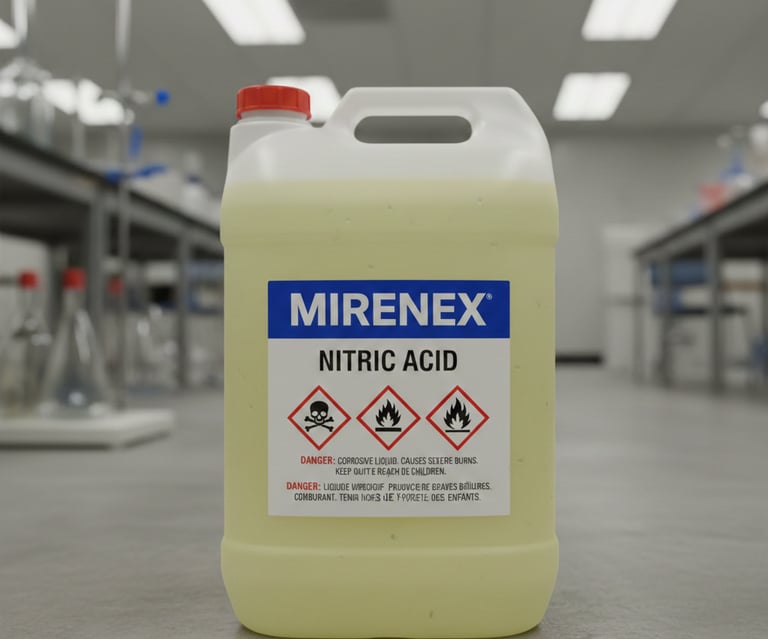
Nitric acid (HNO3) is one of the most important mineral acids in the chemical industry. It is a highly corrosive agent, a powerful oxidant, and an essential intermediate in many production lines.
1. Technical Specifications and Properties
Pure nitric acid is a colorless liquid, but it often turns yellow or brown over time due to decomposition into nitrogen dioxide (NO2).
Chemical formula: HNO3
Molar mass: 63.01 g/mol
Density: Approximately 1.51 g/cm³ (for the pure form).
Typical concentrations: Commercial acid: 68% (azeotropic with water).
Fuming acid: > 86% (emits reddish-brown NO2 fumes).
Solubility: Completely miscible in water with an exothermic reaction (release of heat).
2. Chemical Aspect and Reactivity
Nitric acid is distinguished by two major chemical behaviors:
Strong Acid: It dissociates almost completely in water, making it extremely effective for attacking metals and adjusting pH.
Powerful Oxidizing Agent: Unlike hydrochloric acid, it can oxidize base metals (such as copper or silver) by releasing nitrogen oxides rather than hydrogen.
Nitroating Agent: When mixed with sulfuric acid (H₂SO₄), it forms the nitronium ion (NO₂⁺), which can attach nitro groups to organic molecules.
Contact us
Ready to optimize your production? Our experts are available to analyze your specific needs.