Processing and Regulation Agents
Caustic soda
3. Chemical and Industrial Applications
Sodium hydroxide (Sodium hydroxide) is involved in an impressive number of processes:
Mining and Metallurgy: (This is one of the most widespread uses of sodium hydroxide):
Alumina Extraction (Bayer Process): Sodium hydroxide is essential for dissolving bauxite to produce aluminum.
Gold Processing: Used to adjust the pH during cyanide leaching and to regenerate activated carbon.
Ore Flotation: It serves as a pH regulator to optimize the separation of precious minerals from waste rock.
Soap Making (Saponification): It is the key reagent for transforming fats (oils/greases) into solid soap.
Water Treatment: Used to neutralize water acidity and regulate pH in wastewater treatment plants.
Paper Industry: It dissolves the lignin in wood to extract the cellulose fibers needed for paper pulp production.
Organic Synthesis: It serves as a neutralizing agent, catalyst, or reagent in the production of dyes, pharmaceuticals, and plastics.
Metallurgy: Essential in the Bayer process for extracting alumina from bauxite ore.
4. Strengths of Caustic Soda
Reactive Efficiency: As a strong base, it reacts quickly and completely with acids.
Versatility: It can break down organic matter (fats, proteins, hair), making it an extremely effective drain cleaner.
Cost: Its large-scale production (by electrolysis of sodium chloride) results in a relatively low industrial cost.
Availability: It is a standard product available worldwide in various concentrations.
⚠️ Safety and Handling
Due to its hazardous nature, handling caustic soda absolutely requires:
Wearing chemical safety goggles (risk of immediate blindness).
Nitrile or neoprene gloves.
Adequate ventilation.
Golden rule: Always pour caustic soda into water, and never water into caustic soda (to avoid splashes due to exothermic reaction).
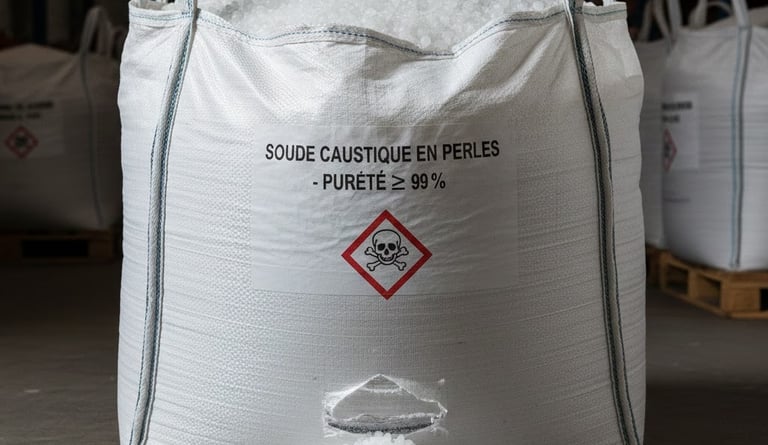
Caustic soda, scientifically known as sodium hydroxide (NaOH), is one of the most powerful and widely used bases in the global chemical industry.
1. Chemical Aspects and Properties
From a molecular perspective, caustic soda is a strong Brønsted base. It dissociates completely in water to release sodium ions (Na+) and hydroxide ions (OH-).
Essential Formula: NaOH
Hygroscopic Character: It rapidly absorbs moisture and carbon dioxide (CO2) from the air.
Exothermic Reaction: Its dissolution in water releases intense heat, which can cause splashing if not handled carefully.
pH: In solution, it has a very high pH (close to 14 for a molar solution).
2. Technical Specifications
We ensure that our product meets the following performance criteria:
Purity: > 98%
Solid Form: Pearls/Flakes
Appearance: Opaque white solid
Molar Mass: 39.997 g/mol
Density: 2.13 g/cm³
Melting Point: 318 °C
Packaging type: Big Bags (Jumbo Bags) 1000 kg to 1500 kg & 25 kg / 50 kg bags.
Contact us
Ready to optimize your production? Our experts are available to analyze your specific needs.