Recovery Solutions
Activated charcoal
Solutions de Récupération
3. Main Applications
In the Mining Sector (Hydrometallurgy)
This is one of the most critical applications, particularly for gold extraction.
CIP/CIL (Carbon-In-Pulp/Carbon-In-Leach) Processes: Activated carbon is mixed with ore pulp to adsorb the gold dissolved by cyanide.
Recovery: The gold-laden carbon is then separated, and the gold is recovered by elution (desorption).
In Chemical and Industrial Applications
Decolorization: Removal of colored impurities from organic solutions (sugar, edible oils, pharmaceuticals).
Catalysis: Used as a support for metallic catalysts (such as palladium on carbon, Pd/C).
Air Treatment: Capture of VOCs (Volatile Organic Compounds) and solvents.
Other applications
Water treatment: Removal of chlorine, pesticides, tastes, and odors from drinking water.
Medicine: Used in cases of poisoning or drug overdose to adsorb toxins in the digestive tract
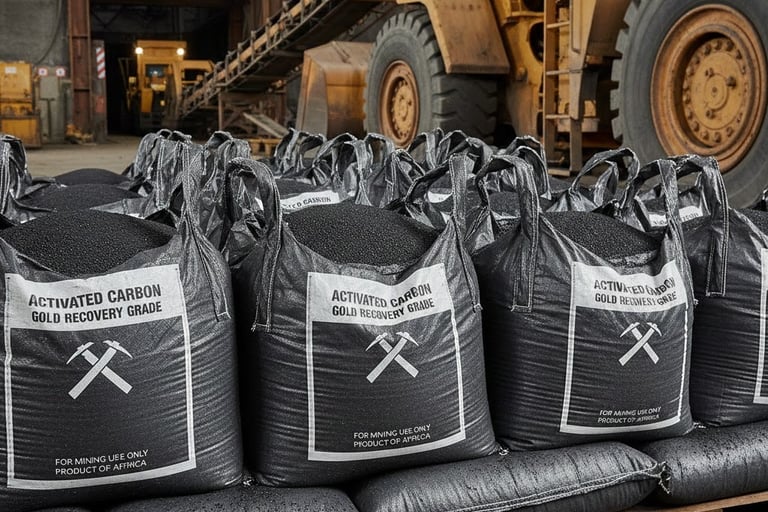
Activated carbon (or activated charcoal) is an exceptional porous carbonaceous material, used primarily for its ability to bind molecules through adsorption. Unlike ordinary carbon, it undergoes a specific treatment to maximize its internal surface area.
1. Chemical Aspect and Structure
From a chemical standpoint, activated carbon is composed essentially of carbon atoms arranged in disordered graphitic sheets.
Adsorption: This is the key phenomenon. Unlike absorption (where a substance enters the volume), adsorption binds molecules to the surface of the pores through Van der Waals forces (weak physical bonds).
Porous Structure: It has a highly porous structure classified into three categories:
Micropores (< 2 nm): For small molecules (gases, odors).
Mesopores (2-50 nm): For medium-sized molecules (dyes).
Macropores (> 50 nm): Serve as access channels to the interior.
2. Technical Specifications
To assess the quality of activated carbon, several standard indicators are used:
Specific Surface Area (SSA): This expresses the total available surface area. It generally varies between 500 and 1500 m²/g. (A single gram can have the surface area of a football field).
Iodine Value (mg/g): Measures the adsorption capacity of small molecules (micropores). This is the most common performance indicator.
Methylene Blue Value: Measures the adsorption capacity of large molecules (mesopores).
Apparent Density: Important for filter sizing.
Ash Content: Indicates the purity of the product (mineral residues after combustion).
Contact us
Ready to optimize your production? Our experts are available to analyze your specific needs.