Industrial Acids
Acide Chlorhydrique (HCI)
3. Applications in the Mining Industry
Hydrochloric acid is a strategic reagent in the extractive sector:
Ore Leaching: Used to dissolve certain precious or base metals from complex ores.
Rare Earth Processing: Essential for the separation and purification of rare earth elements.
Resin Regeneration: In mine water treatment, it is used to regenerate saturated ion-exchange resins.
Well Acidification: Injected into rock formations (carbonates) to increase permeability and facilitate resource extraction.
4. Other Industrial Applications
Steel Processing (Pickling): This is the primary use. It removes iron oxide (rust) from the surface of steel before rolling or galvanizing.
Food Industry: Used for protein hydrolysis, gelatin production, and as a pH regulator.
Water Treatment: Adjusting the pH of wastewater and swimming pools.
Organic Synthesis: Manufacturing of PVC, polyurethane, and various pharmaceuticals.
5. Strengths and Advantages
Efficiency: As a strong acid, it reacts very quickly, reducing industrial cycle times.
Cost: It is relatively inexpensive to produce on a large scale compared to other organic or mineral acids.
Versatility: It is used in both heavy-duty cleaning and fine chemical synthesis.
Salt Stability: The chlorides resulting from its reactions are often highly soluble in water, facilitating separation processes.
⚠️ Safety and Handling
Hydrochloric acid is extremely corrosive. It requires rigorous personal protective equipment (PPE) and storage tanks made of resistant materials (HDPE type plastics or special alloys).
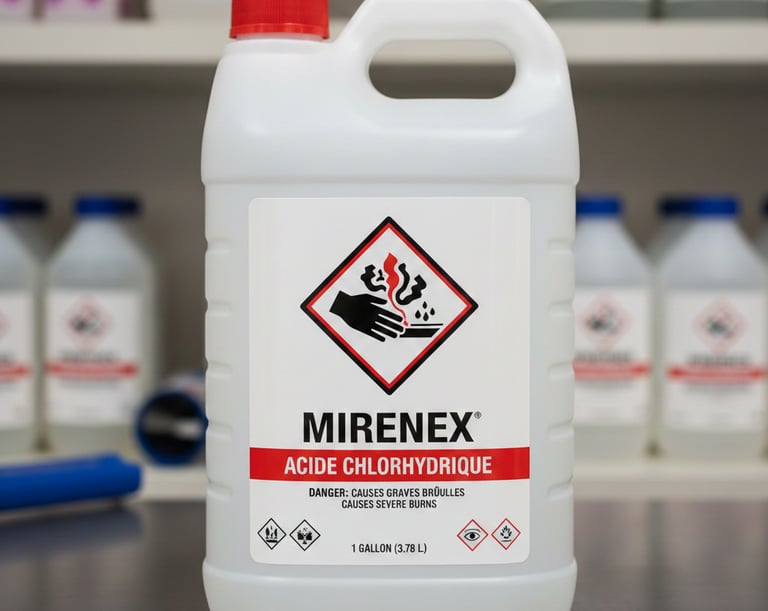
Hydrochloric acid (HCl) is one of the most fundamental and widely used chemicals in global industry. It is an aqueous solution of hydrogen chloride gas.
1. Technical Specifications and Physical Properties
Commercial hydrochloric acid is generally available in concentrations ranging from 30% to 37%.
Molecular formula: HCl
Molar mass: 36.46 g/mol
Appearance: Colorless to slightly yellowish liquid (a yellow tint often indicates traces of iron or free chlorine).
Odor: Pungent and irritating (smokes in open air at high concentrations).
Density: Approximately 1.18 for a 37% solution.
pH: Very acidic (less than 1).
2. Chemical Aspect and Reactivity
Hydrochloric acid is a strong acid that dissociates completely in water.
Dissociation: In water, it releases hydronium ions (H3O+) and chloride ions (Cl-).
Reaction with metals: It attacks most metals (iron, zinc, aluminum) by releasing hydrogen gas (H2) and forming chloride salts.
Neutralization: It reacts vigorously with bases (such as sodium hydroxide, NaOH) to form sodium chloride (table salt) and water.
Contact us
Ready to optimize your production? Our experts are available to analyze your specific needs.